🚀 AI Model Cost vs Skill & Planning: Why Better Engineers Build Faster and Cheaper More tokens and expensive models don’t always me
Originally published on LinkedIn
🚀 𝗔𝗜 𝗠𝗼𝗱𝗲𝗹 𝗖𝗼𝘀𝘁 𝘃𝘀 𝗦𝗸𝗶𝗹𝗹 & 𝗣𝗹𝗮𝗻𝗻𝗶𝗻𝗴: 𝗪𝗵𝘆 𝗕𝗲𝘁𝘁𝗲𝗿 𝗘𝗻𝗴𝗶𝗻𝗲𝗲𝗿𝘀 𝗕𝘂𝗶𝗹𝗱 𝗙𝗮𝘀𝘁𝗲𝗿 𝗮𝗻𝗱 𝗖𝗵𝗲𝗮𝗽𝗲𝗿 More tokens and expensive models don’t always mean best results. In fact, often the opposite can be true.
A tightly constructed context almost always beats a sprawling one. Recently I ran an experiment.
I had a large spec-first build underway. Not my usual style, I prefer lightweight specs and iteration, but this time I went deep to properly test the approach.
🧠 Two weeks of background engineering first: • Functional requirements / research • Non-functionals • Explicit constraints • Trade-offs • Technical references • Mermaid diagrams • Defined standards • Phases / Execution checkpoints • Testing strategy (unit+ E2E)
This wasn’t winging it. This wasn’t “read the code and adapt.” This was engineering, not coding, solution design, architecture, principles and practice.
The non-functionals alone required serious thought: performance, domain boundaries, failure modes, scalability, operations. The hard thinking was done before execution.
I’m a Cursor user (primarily Sonnet) and hit my subscription limit. No premium model left, just the basic “auto” tier.
Normally I’d never choose it for something this size. But this was an experiment, no client waiting, just my research and budget.
So I let it run with auto.
⚙️ Two to three days of execution.
⚙️ Light supervision at checkpoints.
And here’s what surprised me: • It adhered to the architecture. • It followed the standards. • It respected the constraints.
Was it perfect? No, but a premium model would still need finishing touches.
But the volume of high-quality, standards-aligned output was beyond what I expected at far lower a cost.
I assumed I’d rebuild it later on a larger model but I didn’t need to.
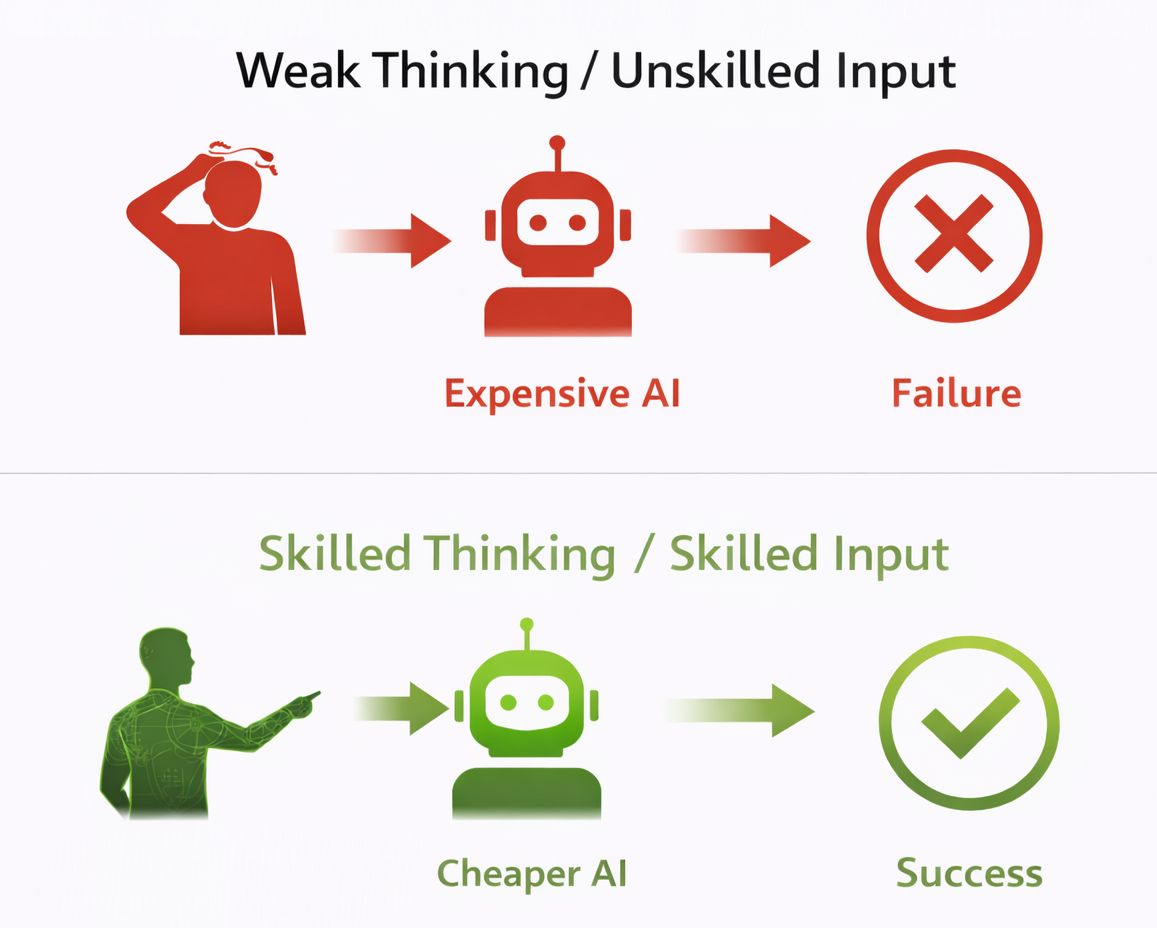
Here’s the takeaway from that: • I wasn’t paying for intelligence. • I was paying for ambiguity tolerance.
Bigger models are exceptional at filling design gaps and inferring missing structure. What engineers often slate as “hallucination” is just the model compensating for weak input.
When architecture is explicit, there are no gaps to fill. The better you are at engineering, the less you need a “superstar” model. • If the thinking is weak, you pay for intelligence. • If the thinking is strong, you pay for execution.
That’s a very different cost equation.
We assume
Bigger model → Better output → Worth the cost.
But a more accurate equation might be
Better engineering → Lower model requirement → Lower cost → Same (or better) outcome.
AI doesn’t replace engineering discipline, it amplifies it.
So I’m curious:
💬 Where are you seeing the biggest return on AI investment right now? • Larger models? • Context design? • Tooling and orchestration? • Stronger engineering fundamentals? • New processes?
What’s moving the needle?
#AI #ArtificialIntelligence #SoftwareArchitecture #EngineeringLeadership #AIEngineering #TechStrategy #CostOptimization