AI Makes Good Architecture More Important, Not Less
Originally published on LinkedIn
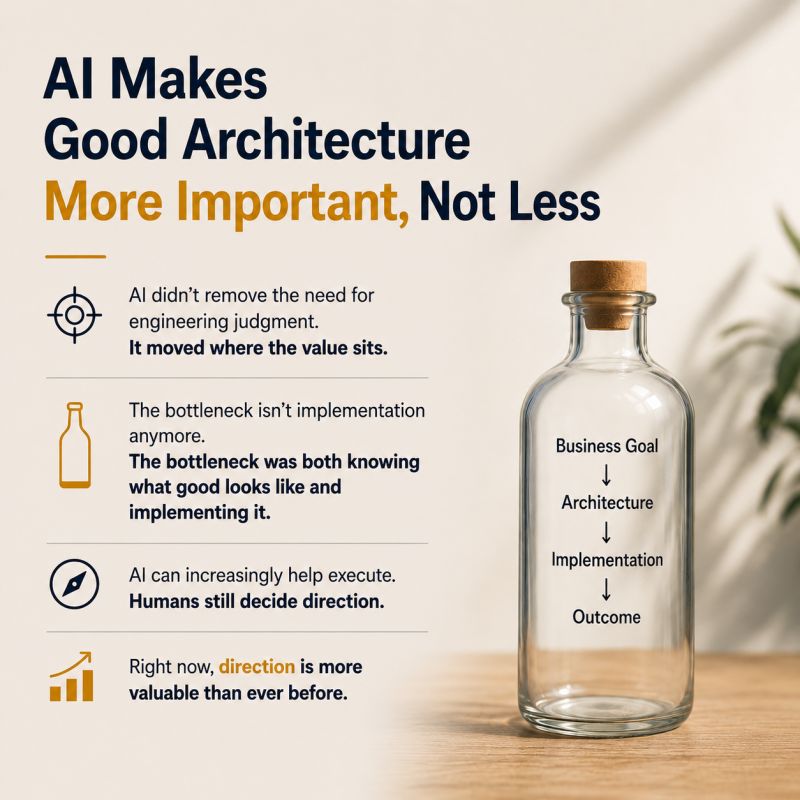
𝗔𝗜 𝗠𝗮𝗸𝗲𝘀 𝗚𝗼𝗼𝗱 𝗔𝗿𝗰𝗵𝗶𝘁𝗲𝗰𝘁𝘂𝗿𝗲 𝗠𝗼𝗿𝗲 𝗜𝗺𝗽𝗼𝗿𝘁𝗮𝗻𝘁, 𝗡𝗼𝘁 𝗟𝗲𝘀𝘀
I was having a conversation with an engineer friend recently.
He joked:
"I'm a finisher. You're a starter."
I laughed and replied:
"I'm finishing this one."
I'm an architect used to handing over designs, plans, and strategy to engineering teams. Building your own product with your own money makes you question whether that hand-off is worth it.
There was something interesting underneath the joke.
For years, software teams have largely been built around specialised roles and hand-offs.
Business goal → requirements → architecture → development → testing → release
The process is inefficient and built around moving work between people. AI has changed the shape of that work, and you have to decide whether that handover is more costly than beneficial.
Over the last couple of years, I've spent a lot of time building with AI complex applications that, as a single engineer/architect, would previously have required entire teams.
Not just:
"Write me some code."
But:
🔹 Review standards
🔹 Improve test coverage
🔹 Run regression checks
🔹 Apply patterns consistently
🔹 Validate changes
🔹 Challenge assumptions
AI didn't remove the need for engineering judgment.
𝗜𝘁 𝗺𝗼𝘃𝗲𝗱 𝘄𝗵𝗲𝗿𝗲 𝘁𝗵𝗲 𝘃𝗮𝗹𝘂𝗲 𝘀𝗶𝘁𝘀.
I don't accept the argument that implementation was never the bottleneck — otherwise every engineer I've met would have launched dozens of products.
Later in the conversation my friend asked me:
"How has architecture changed in the world of AI?"
I don't think architecture has become less important, it has become more important.
When development speed increases dramatically, you can explore ideas faster and change direction more easily.
⚠️ But you can also build yourself into a corner faster than ever before.
So my own approach has changed:
• Lighter upfront design • More experimentation • More frequent architectural reviews • Faster course correction
Less:
"Produce a huge design document."
More:
"Build, learn, adjust."
The biggest shift though is around engineers themselves.
I used to think in terms of specialists for the right job, now I think in terms of ownership and completing the goal.
The engineers who seem likely to thrive aren't necessarily the people who can write code fastest.
They're the people who can connect:
Business goal → architecture → implementation → outcome
People who understand not just whether something works, but whether it will still be the right decision in six months.
At one point in the conversation I said:
"You need to know what good looks like and be able to describe it."
I think that's becoming one of the most valuable skills in software engineering.
AI can increasingly help execute.
𝗛𝘂𝗺𝗮𝗻𝘀 𝘀𝘁𝗶𝗹𝗹 𝗱𝗲𝗰𝗶𝗱𝗲 𝗱𝗶𝗿𝗲𝗰𝘁𝗶𝗼𝗻.
Right now, direction is getting more valuable than ever.
#AI #SoftwareEngineering #Architecture #Leadership #ProductEngineering