AI is making the debugger obsolete.
Originally published on LinkedIn
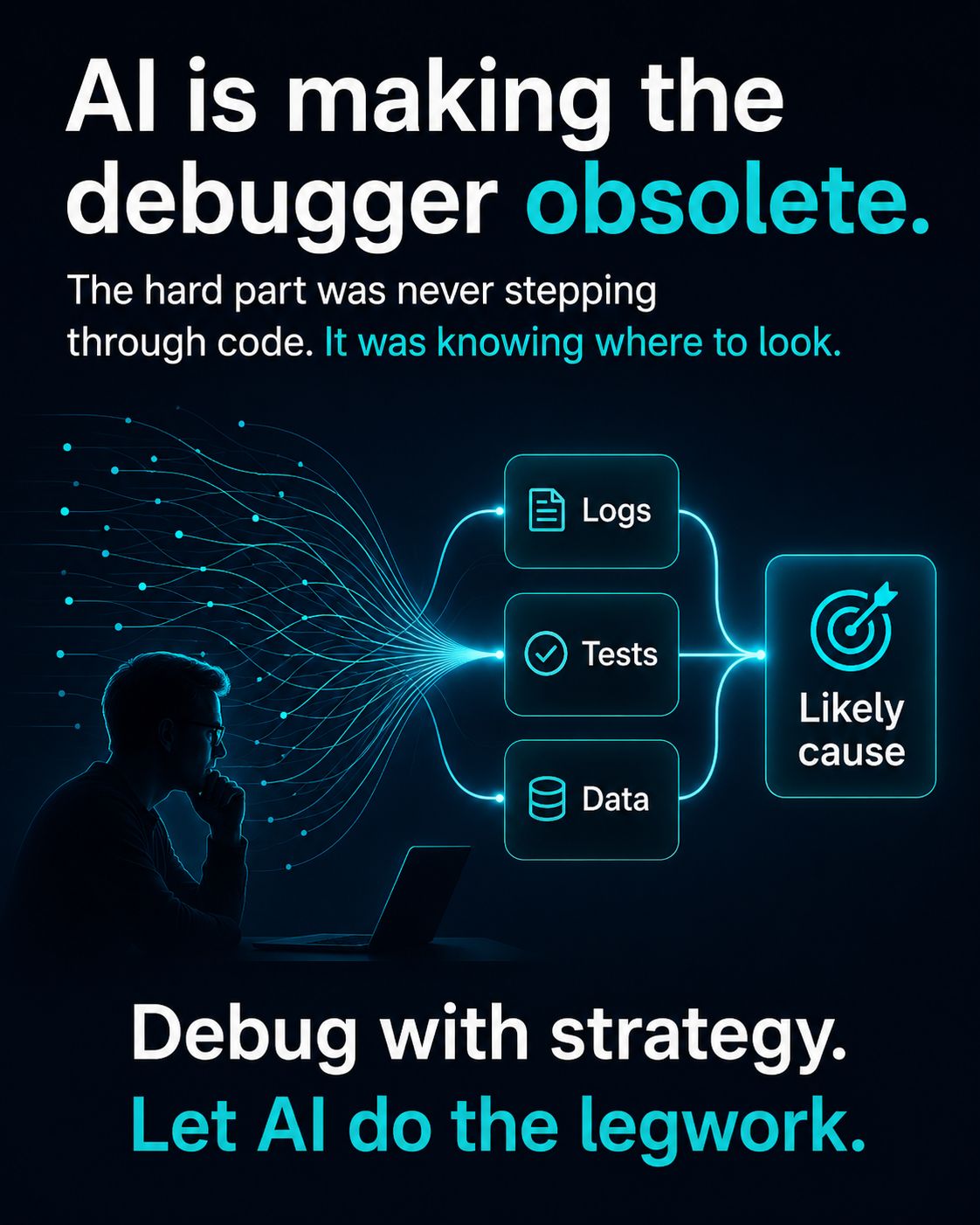
𝗔𝗜 𝗶𝘀 𝗺𝗮𝗸𝗶𝗻𝗴 𝘁𝗵𝗲 𝗱𝗲𝗯𝘂𝗴𝗴𝗲𝗿 𝗼𝗯𝘀𝗼𝗹𝗲𝘁𝗲.
I’m not saying debugging is obsolete. But the way we have always done it is rarely the right way now.
I build heavily with AI and realised I rarely now use a debugger anymore.
I spent a huge part of my engineering carear debugging: sustained engineering, operations, production issues, ugly failures, edge cases.
So this isn’t coming from someone who doesn’t value debugging. The opposite.
Using a debugger was never the hard part of debugging.
One thing I’ve had to hammer into engineers over the years is:
Don’t just sit there debugging. Use your brain first. Before you step through anything, narrow the problem.
🔎 What do we know?
🔎 What changed?
🔎 What can we eliminate?
🔎 What are the two or three most plausible explanations?
Don’t debug a hundred possibilities one by one.
Reason about the system first. Eliminate most of them. Then investigate the few worth your time.
You might be wrong and have to come back to one. Fine.
That thinking is debugging.
The debugger is just one tool you might use once you’ve decided where to look.
And that’s why AI has changed this so much for me.
When I get a bug now, I rarely say:
“AI, fix this bug.”
Well… occasionally if it’s trivial 😉
Normally I think about the investigation strategy first:
🧭 Narrow the logs to the affected period
🗄️ Check the database state
🔀 Look at recent code changes
📊 Add targeted diagnostics
🧪 Create a red test that reproduces the failure ↔️ Compare expected vs actual behaviour
Then I give that strategy to the AI.
Why would I manually do the mechanical work myself?
The AI can search logs, inspect data, trace code paths, add diagnostics, reproduce the failure, and bring the evidence back to me.
Then I decide what makes sense.
I’m not out of the loop. If anything, I’m more in the loop.
My time goes on the part that requires engineering judgement:
🧠 Where should we look?
🧠 What evidence matters?
🧠 What hypotheses are plausible?
🧠 Which fix is actually correct?
None of this happens by magic.
I have AI skills around logs, production failures, database state, diagnostics, and testing hypotheses.
More importantly, I’m building software to be observable and debuggable from day one.
If you’ve generated code you don’t understand and then have to open a debugger to work out what it did, AI probably hasn’t improved the engineering process much.
But if you understand the system, design it for observability, and encode years of debugging experience into how your AI investigates problems?
Why would you do all the stepping?
When people say:
“AI can write the code, but you’ll still have to debug it.”
I’m curious what they actually mean.
𝗛𝗼𝘄 𝗮𝗿𝗲 𝘆𝗼𝘂 𝗱𝗲𝗯𝘂𝗴𝗴𝗶𝗻𝗴 𝗔𝗜-𝗯𝘂𝗶𝗹𝘁 𝘀𝗼𝗳𝘁𝘄𝗮𝗿𝗲?
👉 Still manually stepping through generated code?
Or designing systems to be observable, giving AI a disciplined debugging strategy, and letting it do the investigative legwork?